The major development in modern technology and artificial intelligence, and their integration into various sectors, even into the daily lives of individuals, raises many questions about their impact on society's relationship with its heritage, especially among new generations. Can these technologies be a threat to this relationship, or can they be tools to empower heritage and develop its presence in society?
Dr. Maryam Al Nuaimi, an educational expert at the Ministry of Education, stated that heritage, customs, and traditions are key components of the Emirati personality and the general personality of society. Therefore, they will remain present despite the development, as they are part of the practices passed down through generations, such as family gatherings on weekends. She pointed out that family members of all ages gather together to prepare traditional meals that parents and grandparents were accustomed to eating. During these gatherings, the young learn from the elders the authentic customs and traditions that represent the foundations of interaction within society, in addition to adhering to the national dress, especially on religious, social, and wedding occasions, and even the specific dialect of each region. This does not conflict with children joining the world's best universities and mastering different languages.
Dr. Maryam added in an interview with "Emirates Today": "Despite the great development witnessed by the Emirates in all fields, this does not conflict with adherence to customs and does not represent a threat to national identity, because we deal with heritage as part of daily life that renews with it, not as something old that is only remembered on specific occasions. This keenness on preserving heritage and instilling it in the minds of adults and children, which the Emirates are distinguished by at both official and popular levels, has made residents of various nationalities in the country get to know this heritage and strive to learn and practice it in many situations and occasions, which indicates its deep roots in society".
Heritage Consultant Halima Al Alawi agreed with Dr. Maryam, emphasizing that family cohesion enhances the presence of heritage. According to customs, a daughter is always close to her mother, learning from her habits, traditional foods, and pride in the traditional dress. Similarly, a son learns from his father the manners of men: how to welcome and honor a guest, and the etiquette of the majlis, which generally characterizes Emirati culture.
She added: "The society of the Emirates is distinguished in that its customs are part of its daily life. Even with the development of the lifestyle in society, our interaction with the vocabulary of heritage develops. This can be called 'empowering heritage,' as we see in the use of traditional handicrafts, popular cuisine, and traditional clothing in modern projects launched by the country's sons and daughters, which have achieved great success inside and outside the country. Also, the trend of many of our girls to learn and use 'Talli' and 'Sadu' embroidery in modern products using modern technologies like artificial intelligence and 3D printing". She noted that the state is making great efforts to support this trend among the new generation to preserve heritage and employ modern technology in this context.
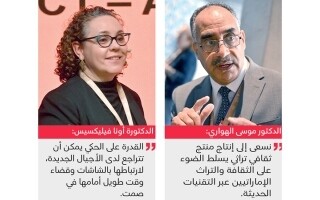
On the other hand, Dr. Musa Al Hawari, Head of the Educational Content Development Department at the Department of Culture and Tourism - Abu Dhabi, believes that one of the most prominent challenges facing the authorities responsible for cultural and heritage content and its development is how to attract the current and new generations, whose main interest is in using modern technology. Achieving this requires a strategy to reach these generations through the tools they master, such as artificial intelligence and others.
He added: "We work in the Education Department at the Department of Culture and Tourism on employing modern technologies to reach the new generation, such as using 3D imaging technology via the cultural platforms and media provided by the culture sector. The sector also provides an educational platform that highlights more than 34 elements of Emirati heritage and culture, especially since half of them are included in UNESCO. These platforms are now used in the Ministry of Education and linked to the curricula".
Dr. Musa explained that the Department has comprehensive tools regarding educational platforms that showcase Emirati culture and heritage, presenting them in a new concept and new tools that reach the youth with innovative methods, linking deep information with a simple approach. This enhances knowledge and awareness of Emirati cultural heritage for the children of the Emirates, residents, or even visitors of various nationalities. The Department provides educational tools to enhance knowledge of local culture in English, Chinese, Korean, and Japanese, in addition to the role played by the country's embassies abroad in introducing Emirati culture and heritage.
He also revealed the Department's direction to produce a product that highlights Emirati culture and heritage through modern technologies, including a project based on using folk games in this context. The student finds themselves inside a falconry game or another traditional game, and through playing, they learn everything related to this field from history, customs, and traditions. He affirmed that preserving heritage and transferring it to the new generation is a societal effort that cannot be done by one party. There must be a national strategy at the state level, and this is the direction of the UAE, which pays attention to the developments of the era while preserving authenticity.
Dr. Ona Felixis, Director of the Documentation and Data Analysis Department at the Department of Culture and Tourism, touched upon the impact of modern technologies on an individual's personality and habits in the future and how this will reflect on their relationship with heritage. She gave an example that folk tales, which are an important part of the intangible heritage of every society, are directly linked to a person's ability to tell stories and turn their imagination and ideas into stories from society, while this ability may regress among new generations due to their dependence on modern devices and spending long hours in silence in front of screens. She called for studying these different aspects.
She also spoke about the ethical rules governing the use of artificial intelligence and modern technologies in the field of heritage. These are global rules that ensure the freedom to obtain and provide information for all, as well as accuracy and credibility and others.
Dr. Ona Felixis, Director of the Documentation and Data Analysis Department at the Department of Culture and Tourism in Abu Dhabi, called for providing more information in Arabic on the internet regarding Emirati popular culture and heritage so that artificial intelligence can use it to provide accurate material. She explained that artificial intelligence is not just algorithms, and if the available data is not digitized, it will be of no use.